
Which standards apply to cement and gypsum exports? Certificates, packaging, documents, cost factors and common mistakes in one guide.
Why Standards Matter So Much
Cement and gypsum directly affect building safety, so they are subject to strict standards in international trade. Compliance is a precondition both for earning the buyer's trust and for smooth customs clearance. A standard is, in essence, a shared technical language between exporter and importer: it defines exactly what is being bought and sold. When both sides refer to the same norm, negotiations become faster and misunderstandings rarer.
A non-compliant lot can be rejected at the destination port and impose heavy costs on the exporter. Beyond the immediate financial loss, a rejected shipment damages a commercial reputation that may have taken years to build. Documenting quality from production to loading keeps this risk to a minimum. Every test report and inspection record is a piece of evidence that the cargo left the factory in the promised condition.
Standards also protect the exporter, not only the buyer. If a quality dispute arises, written specifications and test results provide a neutral point of reference for both sides. Companies that treat compliance as part of their sales strategy rather than a bureaucratic formality tend to win long-term contracts. In building materials, trust is built lot by lot, and standards are the foundation of that trust.
Key Standards and Certificates
For cement, EN 197-1 applies in Europe and TS EN standards in Türkiye, while the EN 13279 series is the reference for gypsum and plaster adhesives. In Russia and the Eurasian Economic Union markets, GOST standards and the EAC conformity mark are required. Each scheme defines its own classes, test methods and labeling rules, so the same product may need different paperwork in different markets.
An ISO 9001 quality management certificate held by the manufacturer is a strong assurance for buyers. Analysis reports from independent inspection companies before export prove that the product matches its declared class. Most professional buyers also ask for recent factory production control records rather than a single historic test.
Beyond product standards, environmental and management certifications are gaining weight in purchasing decisions. Which exact document set a market expects should be clarified at the contract stage, not after production. An experienced trading partner maps these requirements before the first shipment and protects the exporter from costly surprises.
The Certification Process Step by Step
The process begins with identifying the regulations of the target market and the exact category of the product. For the Eurasian Economic Union, this usually means obtaining an EAC declaration or certificate through an accredited body. Product samples are tested in recognized laboratories against the parameters of the relevant standard. The conformity document can be issued only after the test protocols are approved.
Depending on the scheme, a factory audit or an assessment of the production control system may also be required. The paperwork side includes technical data sheets, safety information and labels prepared in the language of the destination market. Incomplete or inconsistent documentation is one of the most common causes of delay at this stage.
Timing deserves special attention: certification should start well before the planned shipment, because laboratory queues and document approvals take time. Certificates also have validity periods, so renewals and scope extensions require calendar tracking. A certificate that expires in the middle of a supply contract can stop shipments entirely.
Packaging and Storage
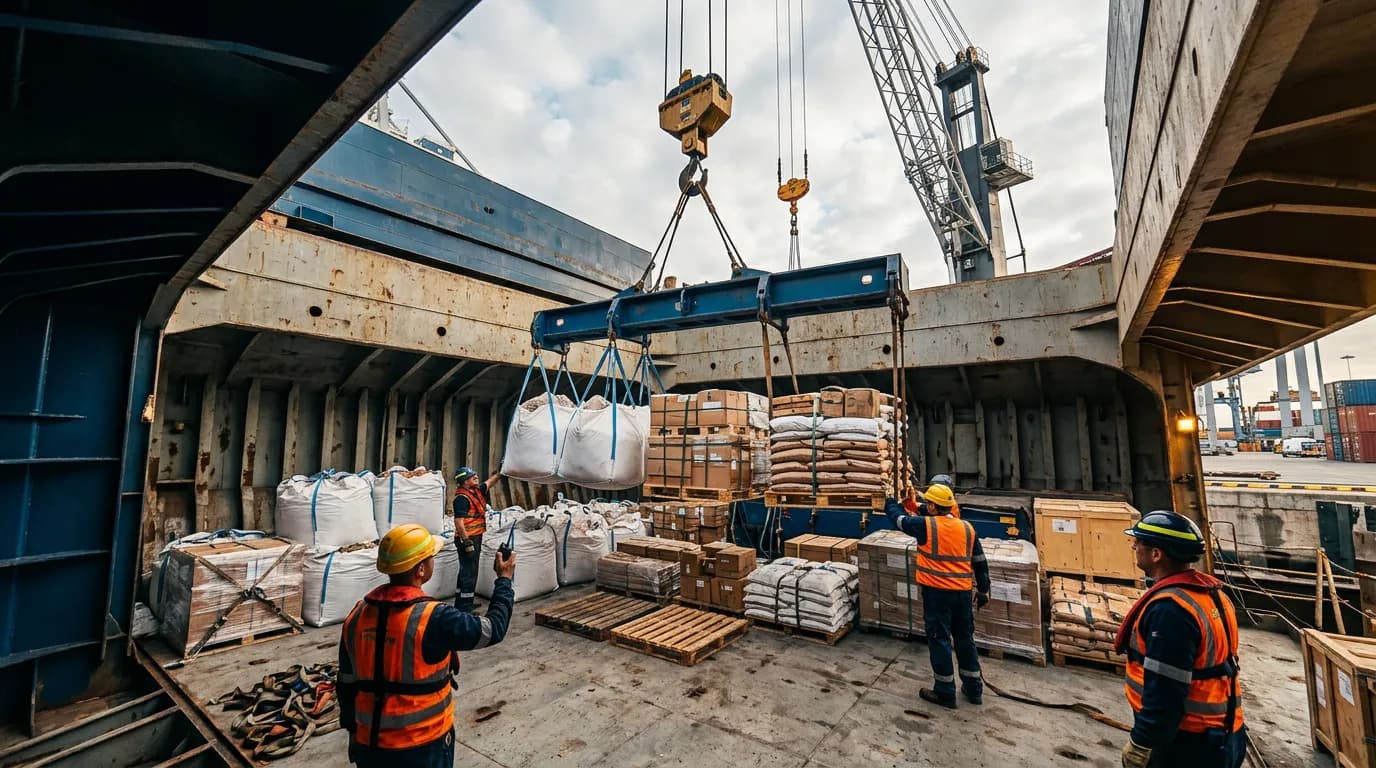
Cement and gypsum are extremely sensitive to moisture, so multi-layer kraft bags or polyethylene-lined big bags are preferred. Bagged products travel on shrink-wrapped pallets, protected from both humidity and physical damage. The choice between bags, big bags and bulk depends on the buyer's handling equipment and the infrastructure of the discharge port.
Ventilation and stowage arrangement in the ship's holds directly affect product quality on arrival. Correct packaging keeps the product within specification throughout the sea voyage. The cleanliness and dryness of the holds should be checked and recorded before loading begins.
Storage discipline before loading matters as much as the packaging itself. Warehouses must be dry and ventilated, with bags kept off the ground on pallets and rotated on a first-in, first-out basis, because cement gradually loses strength as it ages. Waiting time at the port should be planned to be as short as realistically possible.
Quality Control During Shipment
Pre-loading sampling and laboratory tests verify critical values such as compressive strength and setting time. The tests must be carried out on samples taken from the actual lot being shipped, not from earlier production. This is the last point at which a problem can be solved at the factory rather than at sea.
Survey during loading records the bag count and the integrity of the packaging. Photographic documentation of pallets, hold condition and stowage gives both parties an objective record. Any damaged unit should be set aside and replaced before the vessel sails.
Sealed retained samples kept for the agreed period give both sides a neutral basis if a quality question arises later. Independent surveyor reports at loading and at discharge close the evidential chain from end to end. With this discipline in place, most disputes are resolved on paper rather than in court.
The Export Document Set: A Practical Checklist
The core commercial set consists of the invoice, the packing list and the certificate of origin, and the three must be fully consistent with each other. Even small mismatches in weights, lot numbers or product descriptions can trigger customs queries. Harmonized system codes should be confirmed for the destination market in advance.
On the quality side, the set includes test reports, the conformity certificate or declaration for the target market and, where required, safety data sheets. The bill of lading ties the cargo to the contract and to the insurance cover. Each document answers a specific question that customs or the buyer will eventually ask.
A simple internal routine prevents most problems: before the vessel sails, one responsible person checks the complete set against the contract, cross-checking names, codes and quantities. Sharing digital copies with the buyer in advance allows clearance preparations to start before the ship arrives. This habit alone noticeably shortens the time the cargo spends at the destination port.
Common Mistakes and How to Avoid Them
The most frequent mistake is assuming that a certificate valid at home is automatically accepted abroad. Every market runs its own conformity scheme, and the differences are sometimes subtle but always binding. Requirements should be verified with the buyer and a certification specialist before the contract is signed.
The second classic error is underestimating moisture at every stage: torn bags accepted at loading, condensation in poorly ventilated holds, long open-air storage at ports. Each of these can turn a compliant product into a damage claim. Prevention through packaging and handling discipline is always cheaper than compensation.
Paperwork left to the last minute is another recurring problem. Starting certification or document preparation in the final weeks before shipment leads to delays, demurrage and contract penalties. A realistic timeline built backwards from the loading date keeps the process under control.
Finally, choosing the carrier purely on price often costs more in the end. Vessels with poorly maintained holds or unreliable schedules put a moisture-sensitive cargo at risk. Working with partners who know this cargo type and these routes is a quality decision, not just a logistics one.
Cost Factors in Cement and Gypsum Export
The main cost blocks are the product itself, packaging, inland transport, port handling, sea freight, and certification with inspection services. Each behaves differently as volumes grow: packaging scales almost linearly, while certification is largely a fixed cost spread over the shipped quantity. This is why regular, planned shipments are structurally cheaper per ton than one-off deals.
Packaging is the line where saving money most often backfires. Cheap bags tear more easily, increase losses during handling and invite claims that wipe out the saving many times over. The same logic applies to skipping pre-shipment inspection: its cost is small compared to a single rejected lot.
Sea freight on Black Sea routes varies with the season, fuel prices and vessel availability. Exporters who can offer some flexibility on loading dates usually achieve better terms than those locked to a single day. Insurance cover should explicitly reflect the cargo's sensitivity to moisture, since a generic policy may not respond to the most likely damage scenario.
A Real-World Scenario from the Black Sea Trade
Consider a Turkish producer preparing its first shipment of bagged gypsum plaster to buyers in the Rostov region. Before signing, the buyer asks for EAC conformity documents, recent laboratory reports and references on packaging practice. The producer, new to the Eurasian market, partners with a trading company that knows the route and the regulatory landscape.
Certification is started early, samples are tested, and the document set is prepared in Russian alongside the commercial papers. The cargo is palletized, shrink-wrapped and loaded under surveyor control at a Black Sea port such as Karasu. Hold condition is inspected and recorded before a single pallet goes on board.
On arrival, the documents match the cargo, customs clearance proceeds without queries, and the buyer's incoming control confirms the declared class. The first shipment becomes the reference for a regular supply relationship. This is the typical reward of a disciplined first export: not just one successful delivery, but a repeatable trade lane.
Outlook and the Role of Novi Mühendislik
Quality requirements in the building materials trade keep tightening: traceability, environmental performance and digital documentation are requested more often every year. Exporters who invest in systematic quality documentation today will find tomorrow's audits routine rather than stressful. Standards should be read not as a barrier but as a ticket to more demanding, better-paying markets.
The Black Sea corridor remains the natural link between Turkish producers and the markets of Russia and the Eurasian Economic Union. Short sea legs and regular sailings suit moisture-sensitive cargo far better than long multimodal chains. Route knowledge, port relationships and cargo-specific experience together turn this geography into a competitive advantage.
Novi Mühendislik, an Istanbul-based trade and shipping company, follows the entire quality chain in cement and gypsum exports, from factory audit to vessel loading, on routes such as Karasu–Rostov and Ünye–Temruk. This end-to-end approach guarantees that buyers receive the same quality in every lot. If you are planning cement or gypsum exports to the Black Sea basin, the Novi Mühendislik team is ready to walk the standards, documentation and logistics path with you.